About IPv6
IPv6 (Internet Protocol version 6) is the next-generation IP addressing protocol designed to overcome IPv4 limitations and provide enhanced scalability, security, and performance for modern networks. Aviatrix introduces IPv6 support across its multi-cloud networking platform to meet enterprise and federal mandates for dual-stack and IPv6-only deployments.
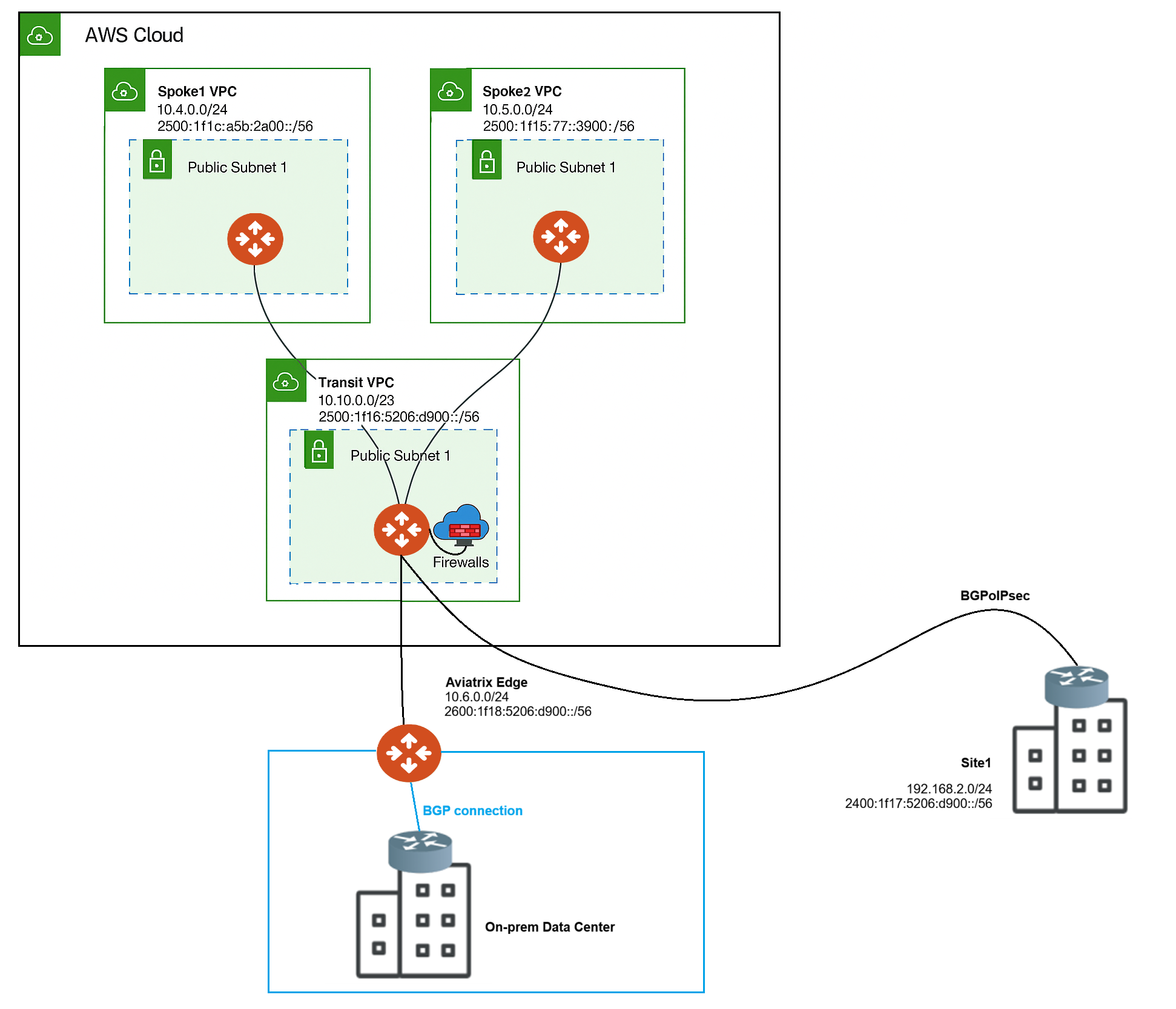
Aviatrix’s IPv6 implementation in Phase 1 focuses on enabling dual-stack deployments across Transit and Spoke Gateways while maintaining compatibility with existing IPv4 workflows. For secure connectivity, BGPoIPSec supports IPv6 with IKEv2, while BGPoLAN IPv6 support is limited on certain CSPs like Azure. Operationally, IPv6 traffic is routed only through addresses learned through BGP sessions, and diagnostics rely on tools like ping6, traceroute6, and tcpdump.
The following figure shows an example of IPv6-enabled nodes that communicate over dual-stack connections:
Benefits of IPv6
-
Address Exhaustion: IPv4’s limited address space is nearly depleted. IPv6 offers a vastly larger address pool.
-
Compliance and Mandates: Federal agencies and global enterprises require IPv6 adoption to meet regulatory and operational goals.
-
Future-Proofing: IPv6 ensures long-term scalability for cloud and hybrid environments.
Key IPv6 Features in Aviatrix Platform
-
Dual-Stack Support: Enable both IPv4 and IPv6 on VPC/VNet, Transit, and Spoke Gateways.
-
Site2Cloud Connectivity: IPv6 support for BGP over IPsec (BGPoIPSec) and LAN (BGPoLAN) for secure S2C connections.
-
Edge Enablement: IPv6 connectivity for Aviatrix Edge gateways to support on-prem to cloud traffic.
-
FireNet Integration: IPv6 traffic inspection for east-west and north-south flows in centralized firewall architectures.
-
Terraform Automation: Management of IPv6 configurations through Terraform.
IPv6 Operational Considerations
-
Global Configuration: Turn On Support for IPv6 toggle in Settings to enable IPv6 features across the Aviatrix platform. See Support for IPv6 on CoPilot for more details.
-
Gateway-Level Settings: Configure IPv6 CIDRs for Transit and Spoke Gateways during creation or edit.
See the following sections for more details:
-
Routing, Diagnostics, and Visibility: IPv6-related information is available in the route tables, diagnostic tools, Topology, and Dashboard sections. See the following sections for more details:
-
Limitations: IPv6-only mode is not supported; only dual-stack deployments are available in Phase 1.