

Business Challenge
Each partner or acquired company connects through its own tunnel, and the connection is usually trusted as a whole. If the partner is compromised, the attacker inherits a path into your network. Different address plans, including overlapping address space after an acquisition, make it hard to write narrow rules, so teams fall back to broad ones.The Business Case for Third-Party Perimeter Security
Risk Mitigation
- Least-privilege partner access. A partner reaches only the workloads and ports that you permit.
- A contained partner compromise. An attacker who controls a partner network does not inherit a path into the rest of your estate.
- Consistent logging. External connections are logged alongside the rest of your firewall policy, so you can investigate partner activity.
Operational Efficiency
- One policy model for internal and external traffic. Rules for partner networks read like the rest of your policy.
- Connectivity without renumbering. NAT on Edge gateways lets networks with overlapping address space, such as an acquired company, connect.
- Narrow rules in place of broad ones. Teams stop falling back to wide permits because the address plans differ.
Strategic Value
- Faster integration of acquisitions. An acquired network connects under policy before you renumber it.
- Partner onboarding on your terms. You define what each partner can reach before the connection goes live.
How Aviatrix Addresses Third-Party Risk
Site2Cloud (S2C) connections terminate on Aviatrix gateways, so Distributed Cloud Firewall (DCF) can enforce rules on traffic that enters or leaves through them. Where the connection terminates determines the enforcement available: a Spoke gateway supports Layer 7 enforcement with active-passive connections and Layer 4 enforcement with active-active connections, and a Transit gateway supports Layer 4 enforcement. Review the DCF and S2C reference before you choose a termination point.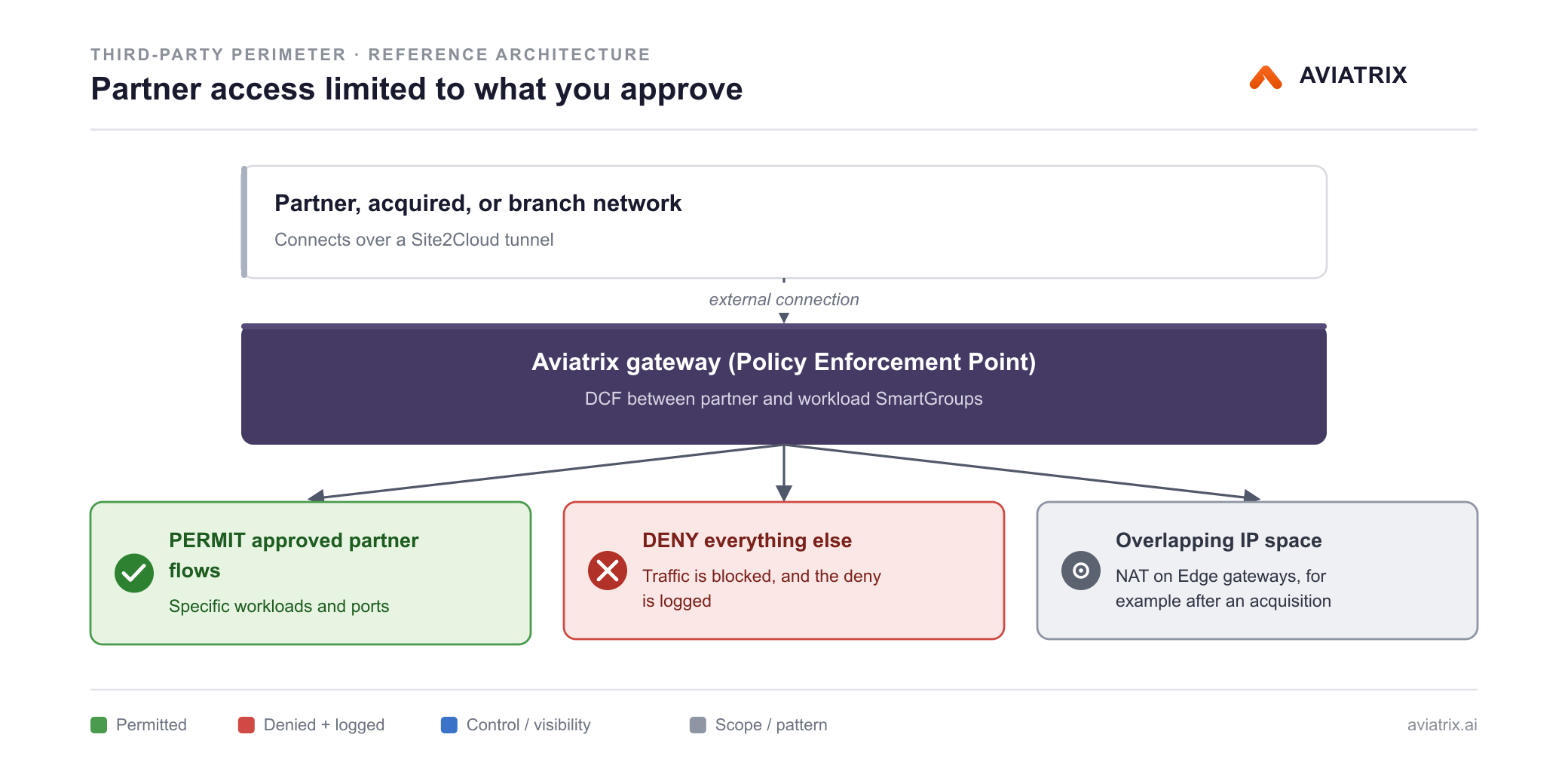
Describe Partner Networks as Groups
A SmartGroup that uses a CIDR range describes a partner or acquired network, and you reference it in DCF rules like any other SmartGroup. ExternalGroups cover Aviatrix-managed destinations outside your estate, such as country, threat, and SaaS feeds.Connect Sites and Partners
Site2Cloud connects remote sites and partner networks to Aviatrix gateways. Edge gateways extend the fabric to locations that are not in a cloud provider, and Edge Transit with Site2Cloud connects those sites to the transit network.Key Components
Site2Cloud
Encrypted connections between Aviatrix gateways and partner, branch, or
on-premises networks.
Distributed Cloud Firewall
Policy between SmartGroups, including partner CIDR ranges, with logging.
ExternalGroups
Aviatrix-managed country, threat, and SaaS feeds for use in DCF rules.
Edge Gateways
Extend the Aviatrix fabric to sites outside cloud providers.
Related Documentation
Use these documents to plan and implement third-party perimeter policy.Configuration Guides
- Creating SmartGroups and ExternalGroups — define the workload and partner sides of a rule.
- DCF With Site2Cloud — enforce policy on S2C connections, including supported termination points.
Reference
- Edge Transit With Site2Cloud Overview — connect non-cloud sites to the transit network.
- About ExternalGroups — group types, feeds, and limits.