

Business Challenge
Flat or loosely segmented networks let an attacker move from an initial foothold to databases, identity systems, and management planes. Host-agent microsegmentation does not cover every workload type, because serverless functions, managed services, and AI agents cannot run an agent. Native security groups are scoped to one VPC or VNet and one cloud, so they cannot express a policy that spans accounts and clouds.The Business Case for East-West Segmentation
Risk Mitigation
- A bounded blast radius. A compromise in one segment cannot reach another unless a rule explicitly permits it.
- Zero trust by default. A deny rule at the end of the policy blocks every flow that you have not permitted.
- Environment separation. Production, development, and shared services stay apart at the routing layer as well as in firewall rules.
- Protection without a host agent. Workloads that cannot run an agent still fall under the same policy when their traffic crosses a gateway.
- Inspection for known attacks. Intrusion prevention drops traffic between workloads that matches attack signatures.
Operational Efficiency
- Identity-based policy, not IP-based policy. Rules reference groups of workloads, so they follow workloads as addresses change.
- One policy across accounts and clouds. Teams stop maintaining a separate rule set for each VPC, VNet, and cloud.
- Safe rollout. Teams observe real traffic in monitor mode, then enforce, and can back out a rule without redesigning the network.
Governance
- A documented baseline. Default deny gives you a written statement of what each segment is allowed to reach.
- A change history. You can see who changed which rule and when as policy tightens.
- Evidence for auditors. Enforced segmentation is a control that you can demonstrate rather than describe.
- Early warning. Anomaly detection highlights unusual traffic patterns, so teams can spot lateral movement while an attacker is still probing.
How Aviatrix Addresses Lateral Movement
Aviatrix Distributed Cloud Firewall (DCF) applies stateful rules between SmartGroups at the gateways that already carry your traffic. Because enforcement sits in the network path rather than on the host, the same policy covers virtual machines and other workloads whose traffic crosses an Aviatrix gateway, within one cloud or across clouds. Traffic that stays inside a VPC or VNet, or that reaches a managed service over a private endpoint, does not cross a gateway, so apply native controls there.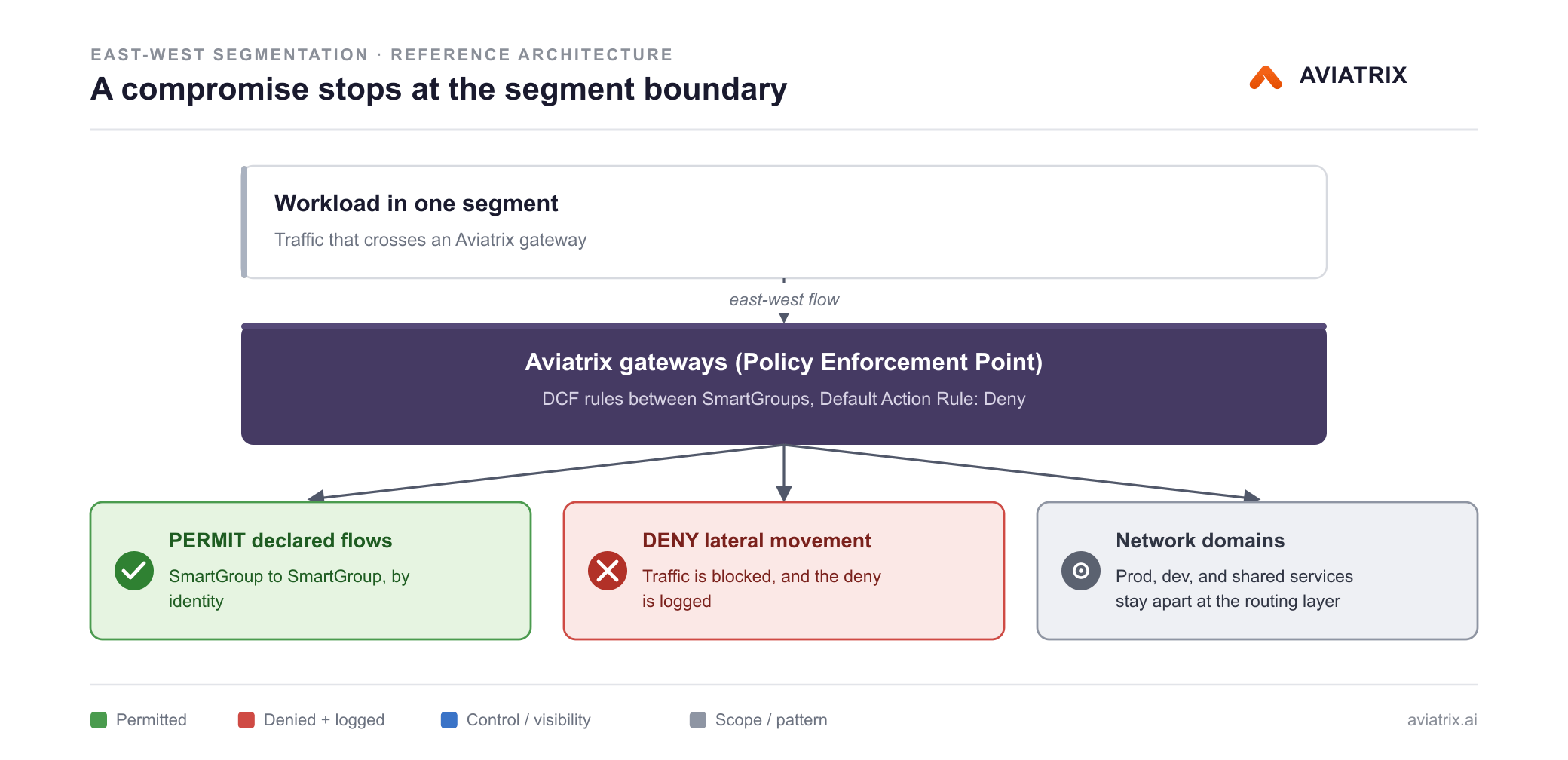
Segment by Identity, Then Enforce Gradually
You group workloads into SmartGroups, for example by tag, resource attribute, or CIDR, and write rules between those groups. Rules start in watch mode so that you see which flows are in use, and move to enforcement after you review the results.Separate Network Domains
Transit Network Segmentation places Spoke attachments in network domains and connects domains only through connection policies. It complements identity-based rules with separation at the routing layer.Protect East-West Traffic in the Fabric
East-west traffic between Spokes, VPCs, and VNets passes through Aviatrix gateways, where DCF can inspect and enforce it. For AWS Transit Gateway environments, you can add transparent protection without replacing the existing Transit Gateway. Where an organization requires third-party next-generation firewalls, Transit FireNet inserts them into the transit path, and DCF handles the rest of the policy.Inspect and Detect
DCF intrusion prevention (IPS) inspects traffic against signature profiles and supports custom rulesets. You attach an IPS profile to the rules that need it, so inspection applies only to the traffic that you select. IPS signatures need visibility into encrypted traffic, so a rule can enable TLS decryption for only the flows that need it. CoPilot Network Behavior Analytics identifies unusual network behavior in your VPCs and VNets that could represent threats, and can alert you when it detects an anomaly.DCF intrusion prevention is generally available in Controller 9.0 and later.
In Controller 8.2, it is a Preview feature.
Key Components
Distributed Cloud Firewall
Stateful, identity-based rules between SmartGroups with a default deny.
SmartGroups
Groups of workloads by tag, resource attribute, or CIDR so that policy
follows the workload.
Transit Segmentation
Network domains and connection policies that isolate groups of Spokes at the
routing layer.
East-West Protection
Enforcement for traffic between Spokes, VPCs, and VNets, including
transparent protection for AWS Transit Gateway.
Intrusion Prevention
Signature-based inspection that you attach to DCF rules.
Network Anomalies
CoPilot detection of unusual network behavior.
Related Documentation
Use these documents to plan and implement segmentation.Configuration Guides
- Enabling Distributed Cloud Firewall — turn on DCF and its default behavior.
- Creating SmartGroups — define the workload identities that your rules reference.
- Auditing DCF Policy Changes — review who changed which rule and when.
- Network Segmentation — configure network domains and connection policies.
- Transparent DCF Protection for AWS Transit Gateway — add east-west enforcement to an existing AWS Transit Gateway design.
- Intrusion Prevention — enable IPS and attach profiles to DCF rules. IPS is generally available in Controller 9.0 and later, and is a Preview feature in Controller 8.2.
- Network Anomalies — review and tune anomaly detection in CoPilot.
- Distributed Cloud Firewall Settings — configure global DCF behavior, including decryption and IPS settings.
- Transit FireNet — insert third-party firewalls in the transit path.
Reference
- Multicloud Design Patterns — reference topologies for Transit and Spoke.
- East-West Overview — supported east-west deployment patterns and Controller versions.
- Distributed Cloud Firewall Capabilities — supported capabilities by Controller version.
- Terraform Provider — declare SmartGroups and DCF rules as code.