

Business Challenge
Cloud workloads reach the internet by default, and a native NAT gateway forwards every outbound connection while recording little about it. A compromised workload or a poisoned dependency can send data to any destination, including over encrypted channels that look like ordinary traffic. Each cloud also ships its own egress controls with its own rule format and limits, so teams that run more than one cloud maintain several policies for one goal. Without one place to see which destinations each VPC or VNet can reach, you cannot tell how much of your estate is covered, and you cannot show an auditor.The Business Case for Egress Control
Risk Mitigation
- Data exfiltration. An outbound path that is closed by default removes the channel an attacker uses to move stolen data out of your estate.
- Command-and-control disruption. A workload that cannot reach an unapproved destination cannot receive instructions or download further tooling.
- Supply-chain exposure. A poisoned dependency can call only the destinations that you approved.
- Known-bad destinations blocked. Managed threat and country feeds stop traffic to destinations that are already known to be malicious.
- Audit evidence. Enforced outbound rules give an auditor a control to inspect instead of an assurance to accept.
Operational Efficiency
- One policy model across clouds. Teams maintain one approach to egress instead of one rule format for each cloud.
- Domain-based allow-lists. Rules reference destination domains rather than IP addresses, so they stay valid when a SaaS provider changes its addresses.
- Allow-lists built from observed traffic. Teams permit the domains that workloads actually call instead of guessing.
- Feeds that stay current. Aviatrix maintains the threat and country feeds, so your team does not curate address lists.
- Reversible rollout. Teams monitor first, protect when the traffic is understood, and return a VPC or VNet to monitoring if an application breaks.
Strategic Value
- Measurable posture. A score for each VPC or VNet lets leaders prioritize work and report progress.
- Egress at the workload boundary. Inspection in the VPC or VNet where traffic originates replaces forwarding every connection through a native NAT gateway.
- A reusable policy model. The same groups and rules that control egress also control east-west traffic, so the investment carries forward.
How Aviatrix Addresses Egress Risk
Aviatrix Distributed Cloud Firewall (DCF) with WebGroups is the recommended way to secure egress. DCF evaluates traffic at the Spoke gateway in the VPC or VNet where it originates, before it leaves the cloud network.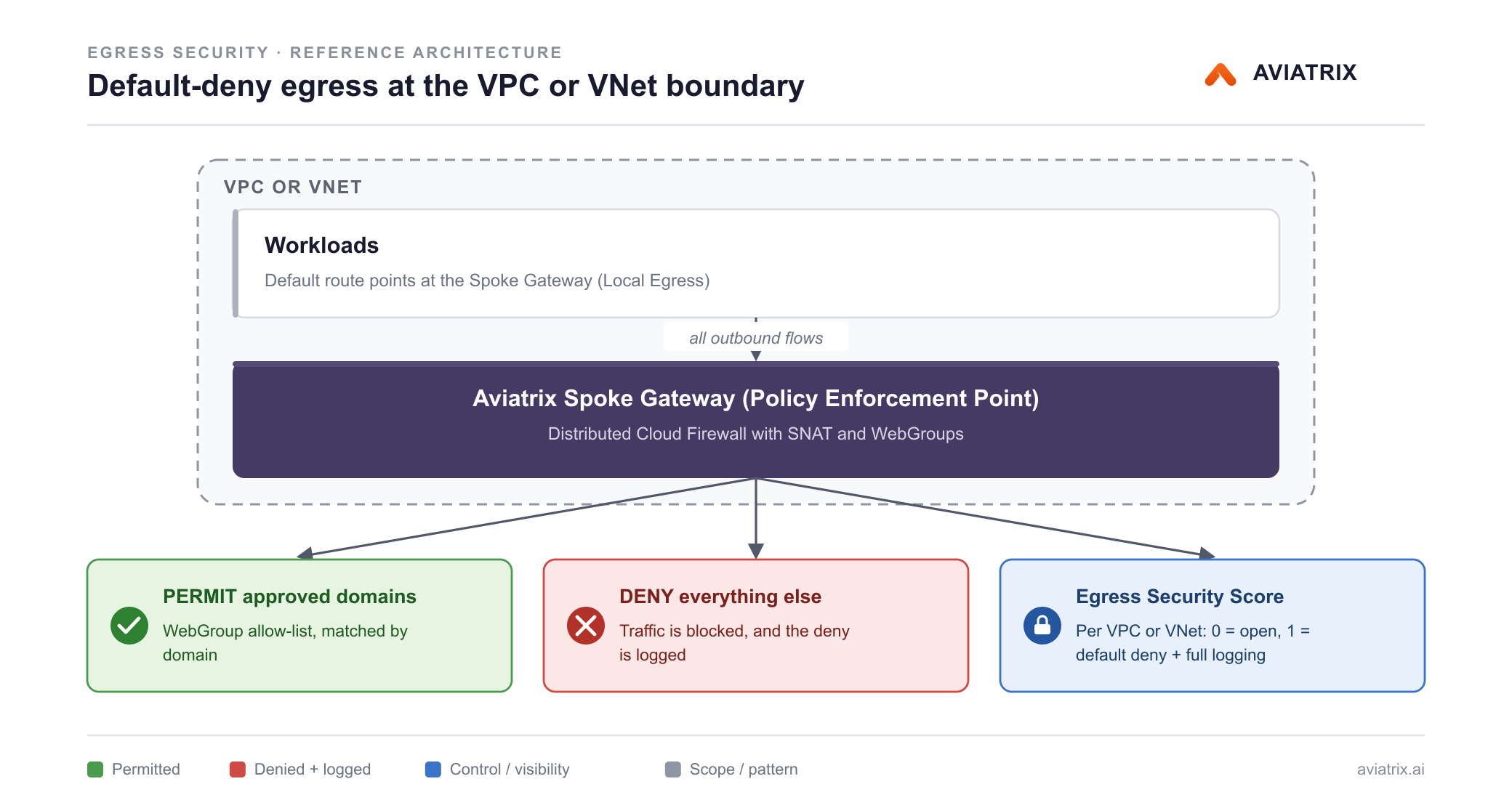
Roll Out in Stages
You move each VPC or VNet from monitoring to protection instead of enforcing everywhere at once. Monitoring shows where workloads connect before any traffic is blocked. Protection permits the trusted domains that you select and denies the rest. If an application breaks, you return the VPC or VNet to monitoring without losing visibility.Allow-List by Domain
WebGroups group the domains that workloads are allowed to reach, so a rule describes a business destination instead of a changing set of addresses.Block Known-Bad Destinations
ExternalGroups use Aviatrix-managed feeds: a threat feed of malicious addresses, a countries feed for geographic policy, and a feed of SaaS services. You reference them in the same rules as SmartGroups and WebGroups. This model replaces the deprecated ThreatIQ and Geoblocking features. You cannot use ThreatIQ or Geoblocking together with DCF and ExternalGroups, so plan the migration as one change. The migration requires Controller 8.1 or later.Inspect Encrypted Traffic Where Policy Requires It
URL-based WebGroups and intrusion prevention (IPS) signatures need visibility into encrypted traffic. A DCF rule can enable TLS decryption for only the flows that need it. You attach an IPS profile to the rules that need inspection, so inspection applies only to the traffic that you select.DCF intrusion prevention is generally available in Controller 9.0 and later.
In Controller 8.2, it is a Preview feature.
Measure Your Posture
The Egress Security Score rates each VPC or VNet from 0 to 1. A score of 0 means traffic is neither blocked nor logged, and a score of 1 means default deny with all outbound traffic logged. CoPilot shows how many VPCs and VNets sit at each protection level.Key Components
Distributed Cloud Firewall
Enforces default-deny egress rules at the Spoke gateway in each VPC or VNet.
WebGroups
Keeps egress rules valid by allow-listing domains instead of IP addresses.
SmartGroups
Applies egress policy to the VPCs, VNets, and workloads you choose.
Egress Security Score
Shows how well each VPC or VNet is protected, in CoPilot.
ExternalGroups and Feeds
Aviatrix-managed threat, country, and SaaS feeds that you use in rules.
Related Documentation
Use these documents to plan and implement egress control.Configuration Guides
- Implementing Egress in an Aviatrix-Managed Network — prerequisites and the overall workflow.
- Monitoring Egress Traffic — see where workloads connect before you block anything.
- Protecting Egress Traffic — permit trusted domains and deny the rest.
- Unprotecting and Monitoring a VPC/VNet — return to monitoring while you troubleshoot.
- Enabling Local Egress — route a VPC or VNet through its Spoke gateway.
- Aviatrix Cloud Firewall Secure Egress Implementation Guide — network design and end-to-end implementation.
- Migrating from Legacy Egress to Distributed Cloud Firewall — move Egress FQDN filtering to DCF and WebGroups. The migration requires Controller 8.1 or later.
- Migrating ThreatIQ and Geoblocking to Distributed Cloud Firewall — replace the legacy features with ExternalGroups.
- Intrusion Prevention — enable IPS and attach profiles to DCF rules. IPS is generally available in Controller 9.0 and later, and is a Preview feature in Controller 8.2.
- Distributed Cloud Firewall Settings — configure global DCF behavior, including decryption and IPS settings.
Reference
- About ExternalGroups — feed types and behavior.
- Egress Security Score — how each score is calculated.
- Distributed Cloud Firewall Capabilities — supported capabilities by Controller version.
- Terraform Provider — declare egress policy as code.