

Business Challenge
Many Kubernetes security tools either add software beside every application (known as a sidecar) or replace the cluster’s networking layer (the CNI plugin). Both choices tie your security model to one platform decision and add cost that grows with the number of workloads. Outbound traffic from a cluster usually leaves through the machine that runs the workload, so the address that a destination sees identifies that machine rather than the application. As a result, you cannot write a rule for what one team’s application is allowed to reach.The Business Case for Kubernetes Workload Security
Risk Mitigation
- Egress control by application and team. Rules apply to a namespace (the part of a cluster that a team or application uses), a pod, or a whole cluster, and describe what a workload is allowed to reach instead of which machine it runs on.
- Domain-based filtering at the boundary. A compromised workload can reach only the destinations that policy permits.
- Unsafe rules rejected before they land. An admission policy engine, which
checks each change before the cluster accepts it, can block a rule such as a
permit to every address (
0.0.0.0/0). - Accountable change. Teams review each policy change in Git, the version-control system, so every change is auditable.
Operational Efficiency
- No extra software in every workload. Gateways enforce egress policy at the VPC or VNet boundary instead of a sidecar beside each application, so cost does not grow with the number of workloads.
- Policy as code. Developers and security engineers write rules in the same kind of configuration files that they use to deploy applications, and review them like code.
- One engine for every workload. Rules, WebGroups, and logging stay consistent across Kubernetes and non-Kubernetes workloads.
Strategic Value
- Platform independence. The same model covers Amazon EKS, Azure AKS, Google GKE, and clusters that you run yourself, so a platform decision does not dictate your security model.
- Shared ownership. Platform and security teams work from one set of controls instead of two.
How Aviatrix Addresses Kubernetes Risk
You connect a cluster to the Aviatrix Controller, a step called onboarding, and define egress policy for its workloads. Distributed Cloud Firewall (DCF) then controls traffic from the cluster to destinations outside the VPC or VNet, where Aviatrix gateways enforce it. DCF for Kubernetes applies to traffic that leaves the VPC or VNet only. For traffic between pods inside a cluster, DCF can translate rules into Kubernetes NetworkPolicy objects, the built-in Kubernetes traffic rules, which the cluster’s networking plugin (CNI) enforces.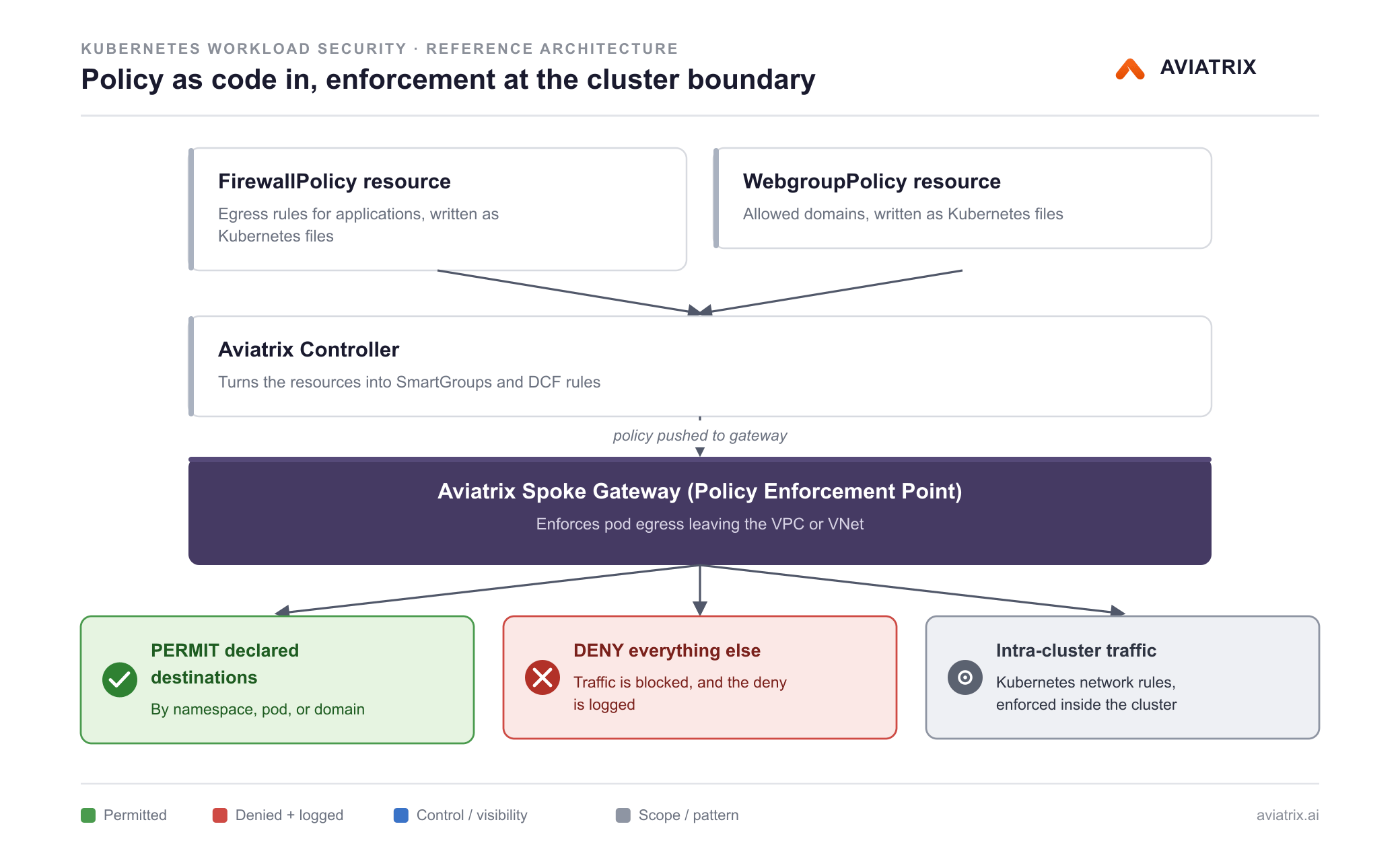
Onboard Clusters
Aviatrix supports Amazon EKS, Azure AKS, and Google GKE, which are the managed Kubernetes services of each cloud. It also supports custom clusters that you run yourself, and private clusters whose management endpoint (the API server) is not exposed to the public internet.Define Policy With Kubernetes Resources
TheFirewallPolicy and WebgroupPolicy custom resource definitions (CRDs) add
Aviatrix policy objects to Kubernetes. You manage egress rules with kubectl,
the standard Kubernetes command-line tool, or with a GitOps pipeline, in which
Git is the source of truth for configuration. Kubernetes role-based access
control (RBAC) controls who can change policy, and an admission policy engine
such as OPA/Gatekeeper or Kyverno rejects unsafe rules.
Key Components
DCF for Kubernetes
Identity-based egress policy for namespaces, pods, and services across EKS,
AKS, GKE, and custom clusters.
Kubernetes CRDs
The
FirewallPolicy and WebgroupPolicy resources for policy as code.SmartGroups
Identity-based selectors that your Kubernetes policy references.
WebGroups
Domain allow-lists for outbound pod traffic.
Related Documentation
Use these documents to plan and implement Kubernetes egress control.Configuration Guides
- Distributed Cloud Firewall for Kubernetes — overview, prerequisites, and workflow.
- Onboard an Amazon EKS Cluster
- Onboard an Azure AKS Cluster
- Onboard a Google GKE Cluster
- Onboard a Custom Kubernetes Cluster
- Onboard a Private Kubernetes Cluster
- Kubernetes Resource Discovery — discover Kubernetes resources in your cloud accounts.
Reference
- Kubernetes CRD Reference
— fields for
FirewallPolicyandWebgroupPolicy, plus RBAC and GitOps guidance. - Kubernetes Prerequisites — cluster and network requirements.
- Distributed Cloud Firewall Capabilities — supported capabilities by Controller version.