

Architecture at a Glance
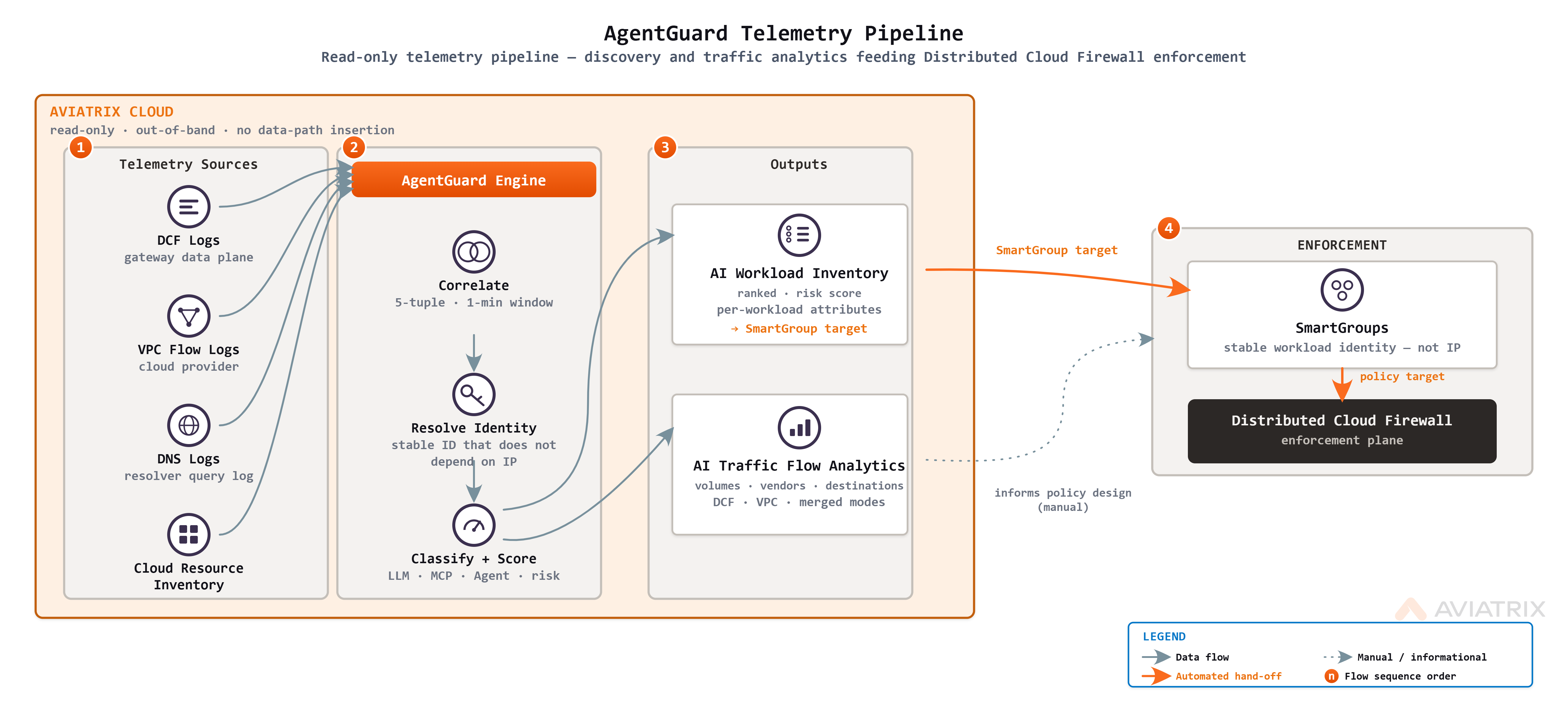
Telemetry Sources
AgentGuard correlates Distributed Cloud Firewall logs, VPC flow logs, and DNS logs with cloud resource inventory to build its workload and traffic views. VPC flow logs are the AWS record of the network connections in a VPC. AgentGuard reads them read-only from the S3 bucket they are delivered to; it does not sit in the data path. VPC flow logs provide breadth. They give AgentGuard visibility into traffic that Distributed Cloud Firewall is not in path for, so AI workloads are discovered even where no gateway is deployed. AgentGuard attributes each flow to an AI vendor from the destination FQDN and the cloud resource identity, then uses this traffic signal — together with network topology — to calculate the blast-radius risk level for each workload. VPC flow logs do not carry application-layer detail. They attribute traffic to AI vendors by FQDN but do not classify it by AI protocol family; that classification requires Distributed Cloud Firewall to be in path. For how these sources are combined and selected per query, see Source Modes in AI Traffic Flow Analytics.Workload Identity
AgentGuard keys each workload to a stable identity hash derived from VPC, workload, application, namespace, and cluster identifiers. Because the key is not an IP address, a workload retains its identity as it reschedules and its address changes.Correlate AgentGuard data with other systems on the workload identity hash,
not on IP address. IP addresses change as workloads reschedule; the identity
hash does not.
Two Levels of Visibility
AgentGuard provides two independent levels of visibility. The level is determined by the telemetry that AgentGuard receives for a given VPC.- Without a gateway — AgentGuard reads VPC flow logs and cloud resource inventory to inventory every AI workload, classify each one by AI vendor, and assign a risk level. This level requires no changes to your network.
- With a gateway (DCF) — When a gateway is in path and Distributed Cloud Firewall inspects the traffic, AgentGuard adds full-detail AI traffic and full AI-protocol classification, and Distributed Cloud Firewall enforces allow, block, and inspect rules.
How AgentGuard Works With the Security Fabric
AgentGuard produces the AI inventory and analytics; the rest of the Cloud Native Security Fabric acts on them. AgentGuard remains read-only so that discovery can run across the entire estate, while enforcement is handled by components designed for it. The following sections reuse the canonical descriptions of those components.Distributed Cloud Firewall
Dynamic Trust Enforcement (DTE) with Distributed Cloud Firewall (DCF) provides advanced security capabilities for your cloud infrastructure. This feature enables organizations to implement zero-trust security policies across their multi-cloud environments.Key Features
- Real-time threat detection - Continuously monitors network traffic for malicious activity
- FQDN filtering - Controls access to specific domains and URLs
- ThreatIQ integration - Leverages threat intelligence for enhanced security
- Distributed enforcement - Applies security policies consistently across all cloud locations
- Zero-trust architecture - Verifies every connection before allowing access
Benefits
Dynamic Trust Enforcement with DCF helps organizations:- Reduce attack surface by controlling outbound traffic
- Prevent data exfiltration through malicious domains
- Maintain compliance with security regulations
- Simplify security management across multi-cloud deployments
- Improve visibility into network traffic patterns
Egress Security
Egress security routes a VPC’s outbound traffic through an Aviatrix gateway so that the traffic is inspected and controlled before it leaves your cloud network. For AI workloads, egress places the gateway in the path of the calls that agents make to external model providers and tool servers. Enabling egress for a VPC deploys and configures the gateway automatically. After egress is enabled and a Distributed Cloud Firewall rule enables AI Inspection, AgentGuard reports the observed AI traffic in full detail rather than inferring it from logs.SmartGroups and WebGroups
SmartGroups and WebGroups define the workloads and destinations that a Distributed Cloud Firewall policy applies to.- A SmartGroup is a logical, self-updating grouping of workloads, matched by cloud tags, Kubernetes labels, or properties. The AI workloads that AgentGuard discovers are addressable as SmartGroup members, and new matching workloads join automatically as they are deployed.
- A WebGroup is a list of destination domains or URLs, such as the domains
of a specific AI provider. Aviatrix provides built-in
avx-ai-*WebGroups for common AI providers, and you can create your own for internal or restricted destinations.
Limitations
- AgentGuard is an Early Access capability; its scope and behavior may change.
- AgentGuard is read-only. It discovers and analyzes but does not enforce; enforcement is handled by Distributed Cloud Firewall, as described in Distributed Cloud Firewall.