

- Aviatrix Hybrid Cloud Connectivity over Private Network
- Aviatrix Hybrid Cloud Connectivity over Public Network
- Transit Connectivity with Redundant Edge
- Transit Connectivity with Redundant Edge and Redundant Circuit
- Multicloud Connectivity with Aviatrix Hybrid Cloud Connectivity
- Aviatrix Hybrid Cloud Connectivity to VLANs
Single Transit with Single Edge
Attachment over Private Network
In this design, a single Edge Spoke Gateway is attached to an Aviatrix Transit Gateway over a private network, such as AWS Direct Connect, Azure Express Route, and GCP Interconnect.

The WAN router exchanges underlay routes with the CSP over the private circuit. The Edge Spoke Gateway builds its tunnels to the Transit Gateways over that underlay.
-
The WAN router runs a BGP session for underlay CSP to exchange routes with the
CSP and the CSP advertises the Transit CIDR, for underlay reachability.
You can also use Aviatrix Edge Spoke Gateway to terminate CSP underlay in
Equinix Network Edge without a need for a WAN router as shown below.


In Equinix Network Edge, the Edge Spoke Gateway runs the underlay BGP session with the CSP itself, so no WAN router is needed.
- The Edge Spoke Gateway LAN interface runs a BGP session to the LAN BGP router, where the LAN BGP router and the Edge Gateway exchange their network address range to each other over the BGP connection.
- The Edge Spoke Gateway is attached to the Aviatrix Transit Gateway in the Transit VPC, as overlay, where the Aviatrix Transit Gateway and Edge Gateway exchange all their CIDRs to each other.
- The Edge Spoke Gateway registration via Management with default route towards the Internet Firewall or router. Registration can be done via the Internet such as per the diagram or via private network.
Attachment over Public Network
In this design, a single Edge Spoke Gateway is attached to an Aviatrix Transit Gateway over the public network. Key ideas are similar to Attachment over Private Network design except the WAN Router provides Internet connectivity to Transit

The WAN router provides internet connectivity to the transit. The tunnels to the Transit Gateways run over the internet.
Single Transit with Redundant Edge
In this design, multiple Edge Spoke Gateways are deployed to provide redundancy over a single private network circuit. Multiple Edge Spoke Gateways can be deployed in Active-Active mode with ECMP or Active-Standby.

Two Edge Spoke Gateways share one private circuit to the transit. Each uses eth0 for WAN, eth1 for LAN and eth2 for management.
Single Transit with Redundant Edge and Redundant Circuits
In this design, multiple Edge Spoke Gateways are deployed with redundant private network circuits. Multiple Edge Spoke Gateways can be deployed in Active-Active mode with ECMP or Active-Standby.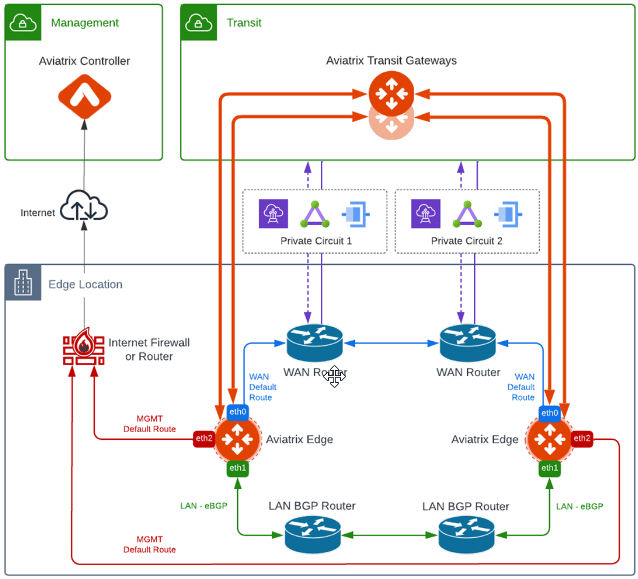
Multicloud Transit Networking with Edge
In a multicloud setup scenario, Edge Spoke Gateway can function as a transitive router providing high-performance encryption and routing the traffic between cloud service providers. The key ideas for this scenario are:- Edge Spoke Gateway is attached to multiple Transit Gateways (for example, Transit in AWS and Transit in Azure)
- Transitive Routing feature is enabled on the Edge Spoke Gateway.
- (Optional) Transit Peering over public network between Transit in AWS and Transit in Azure.
- By default, Transit Peering will be the preferred path. To make Transit Peering less preferred, use Connection AS Path Prepend feature.
- Edge redundancy can be achieved by deploying multiple Edge Spoke Gateways in Active-Active or Active-Standby configurations.


With transitive routing enabled, the Edge Spoke Gateway routes traffic between the clouds. The optional transit peering is the preferred path by default; Connection AS Path Prepend makes it the backup path.
Aviatrix Edge Spoke Gateway Connectivity to VLAN
Aviatrix Edge Spoke Gateway can be deployed in on-premises with LAN gateway functionality and VLAN and VRRP support. Edge Spoke Gateways can connect to a single or multiple Transit Gateways in this design.

The primary and secondary Edge Spoke Gateways share a VRRP virtual IP on each VLAN, so the LAN keeps its default gateway when one of them fails.