

Business Challenge
AI agents operate differently from traditional application workloads. A conventional service calls a fixed set of upstream dependencies; its outbound traffic is deterministic and auditable. An AI agent’s outbound traffic is decided at runtime by the model, based on input the model received. That input can be crafted by an attacker. Prompt injection, compromised tool dependencies, and supply chain attacks against model providers or MCP servers all exploit the same weakness: the agent’s autonomous decision-making gets redirected to serve the attacker’s intent, not the operator’s. The network security gap is structural, and it applies across every agent deployment model. Managed platforms route agent egress through provider-controlled infrastructure with no in-line enforcement point the enterprise security stack can observe. Self-hosted frameworks running on Kubernetes or VMs start with the default-allow posture of the environment. In both cases, the shared responsibility model covers the platform or runtime. It does not cover what the agent inside it chooses to call. An agent that executes a prompt injection and attempts to exfiltrate data to an attacker-controlled endpoint is operating within the platform’s design. The platform forwards that traffic without restriction.March 2026: TeamPCP supply chain attack. The TeamPCP supply chain
attack
compromised four widely deployed AI and security tooling packages (Trivy,
Checkmarx KICS, LiteLLM, and the Telnyx Python SDK) across five package
registries in twelve days. LiteLLM operates under the same trust model as AI
agents: trusted code making real outbound API calls in trusted pipelines. One
engineer added four command-and-control IPs to a DCF Global IP Blocklist. That
single update reached every gateway in the environment before the compromised
packages could communicate. Zero credentials were exfiltrated. Without a
network enforcement point, the outcome is a detection problem after the fact,
not a prevention problem before it.
raw.githubusercontent.com/legitimate-path and
raw.githubusercontent.com/attacker-path present the same TLS endpoint;
SNI-based filtering cannot tell them apart. Catching this class of attack
requires decrypting the connection to inspect the URL path. TLS decryption is
optional: the egress allow-lists and East-West rules in this guide match on SNI
and do not need it, so enable it only for the hosts where you need URL-path
enforcement.
Business Case for AI Agent Containment
Risk Mitigation
Without an enforcement point in the agent’s egress path, the blast radius of any compromise extends to every destination the agent can reach (the entire internet by default). Containment inverts this: the default is deny, and only explicitly declared destinations are reachable. When prevention fails at the application layer, the network boundary determines whether a compromised agent exfiltrates data or fails to open a socket. The egress risk does not exist in isolation. AI agent spokes in an enterprise transit fabric sit alongside other workload spokes: internal APIs, data platforms, finance and HR systems. A compromised agent that can reach the open internet can also pivot to those adjacent workloads unless East-West policy explicitly prevents it. SmartGroup deny rules between the agent spoke and every other spoke in the fabric contain the lateral movement risk to the agent boundary. The blast radius stops at the spoke, not at the edge of the enterprise. Where you need URL-path enforcement, DCF selective TLS decryption can close the supply-chain gap. You enable decryption per rule, and a URL-based WebGroup requires decryption in the rule that uses it. Exclude platform control-plane traffic from decryption to preserve runtime compatibility. Scope decryption to the highest-risk traffic only: it is a targeted capability for cases where SNI-based filtering falls short, not a blanket intercept.Regulatory and Compliance
AI agents handling regulated data create a concrete compliance exposure when their egress is unrestricted. The same audit requirements that apply to other workloads apply here, with the added complexity that agent traffic is harder to characterize than traditional application traffic.Operational Excellence
Policy as code, deployed with the agent. Aviatrix DCF policy is Terraform-native. The WebGroup allow-list for an agent’s permitted tool destinations lives in the same repository as the agent configuration and deploys in the same pipeline run. When an agent adds a new tool endpoint or changes its model provider, the network policy update is a pull request, not a separate change ticket to a different team. East-West containment across the transit fabric. SmartGroups define identity-aware East-West policy between the agent spoke and adjacent workload spokes. A compromised agent cannot pivot to internal APIs, data platforms, or adjacent cloud workloads unless those paths are explicitly declared permitted. The default posture between the agent spoke and every other spoke is mutual deny. Optional, selective TLS decryption. Containment does not depend on decryption. When you need URL-path enforcement, DCF applies decryption per rule, scoped to specific destinations. Exclude platform control-plane endpoints from decryption to preserve certificate-pinning behavior and runtime compatibility regardless of which platform or framework the agent runs on, and limit the decryption surface to the external tool-call traffic where supply-chain risk is highest. Unified visibility across platforms. The same CoPilot dashboard governs agent egress whether agents run on managed cloud platforms, self-hosted orchestration frameworks, or containerized custom runtimes. Security teams can answer “what can any agent reach?” from a single console, without maintaining separate policy engines per platform. Rapid policy propagation. When a new indicator of compromise emerges, an updated containment policy reaches every gateway in the environment before the threat can communicate, with no per-region rollout and no per-platform change window.Competitive Differentiation
Enterprises do not end up running a single agent on a single platform. The operational reality is concurrent deployment across managed platforms such as AWS Bedrock AgentCore and Microsoft Foundry, self-hosted orchestration frameworks like LangGraph, AutoGen, and CrewAI, and new platforms that will be adopted next quarter. Each has its own insertion model, service endpoint requirements, and policy syntax. Managing agent network security with per-platform firewalls means a different policy engine for every agent type, no unified audit trail, and no consistent enforcement primitive across the estate. Aviatrix brings the same unification to AI agent network security that it brought to multicloud networking: one control plane, one policy model, and one audit log across every agent platform and framework. SmartGroups and WebGroups apply consistently whether the agent runs on a managed cloud platform or a self-hosted runtime in a Kubernetes cluster. Gartner projects that 40% of enterprise software will embed agentic AI by 2028. Organizations that standardize on Aviatrix as the agent enforcement plane now are positioned to extend that policy consistently as the agent estate grows, rather than re-architecting security for each new platform.Key Components
Distributed Cloud Firewall
Default-deny enforcement at the Spoke Gateway in the agent VPC or VNet. All
agent egress (tool calls, MCP server connections, model provider traffic,
code interpreter outbound) is intercepted and evaluated against declared
policy before any packet leaves the network boundary.
SmartGroups
Identity-aware source and destination matching keyed to agent workload
primitives: subnet CIDRs for agent instances, cloud provider Service Tags
for platform endpoints, and FQDN patterns. SmartGroups define the egress
source and the East-West boundaries between the agent spoke and adjacent
workload spokes in the transit fabric.
WebGroups
FQDN-based destination filters for permitted tool-call targets: model
provider endpoints, sanctioned MCP servers, and approved REST APIs.
WebGroups enforce the agent’s declared egress allow-list by SNI. URL-based
WebGroups also support optional TLS decryption for URL-path enforcement on
supply-chain-risk hosts.
CoPilot Security Visibility
Centralized dashboard for all agent containment policies, real-time traffic
flows, and per-connection logs across every agent spoke, cloud, and
platform. Security teams get continuous visibility into what every agent can
reach and has actually reached, without querying individual VPCs or
correlating logs across cloud consoles.
Containment Architecture by Platform
The containment pattern is the same regardless of the agent platform:- Deploy a Spoke Gateway in the agent VPC or VNet,
- Route agent egress through it
- Enforce default-deny DCF policy scoped to that workload.
Discover AI Workloads First
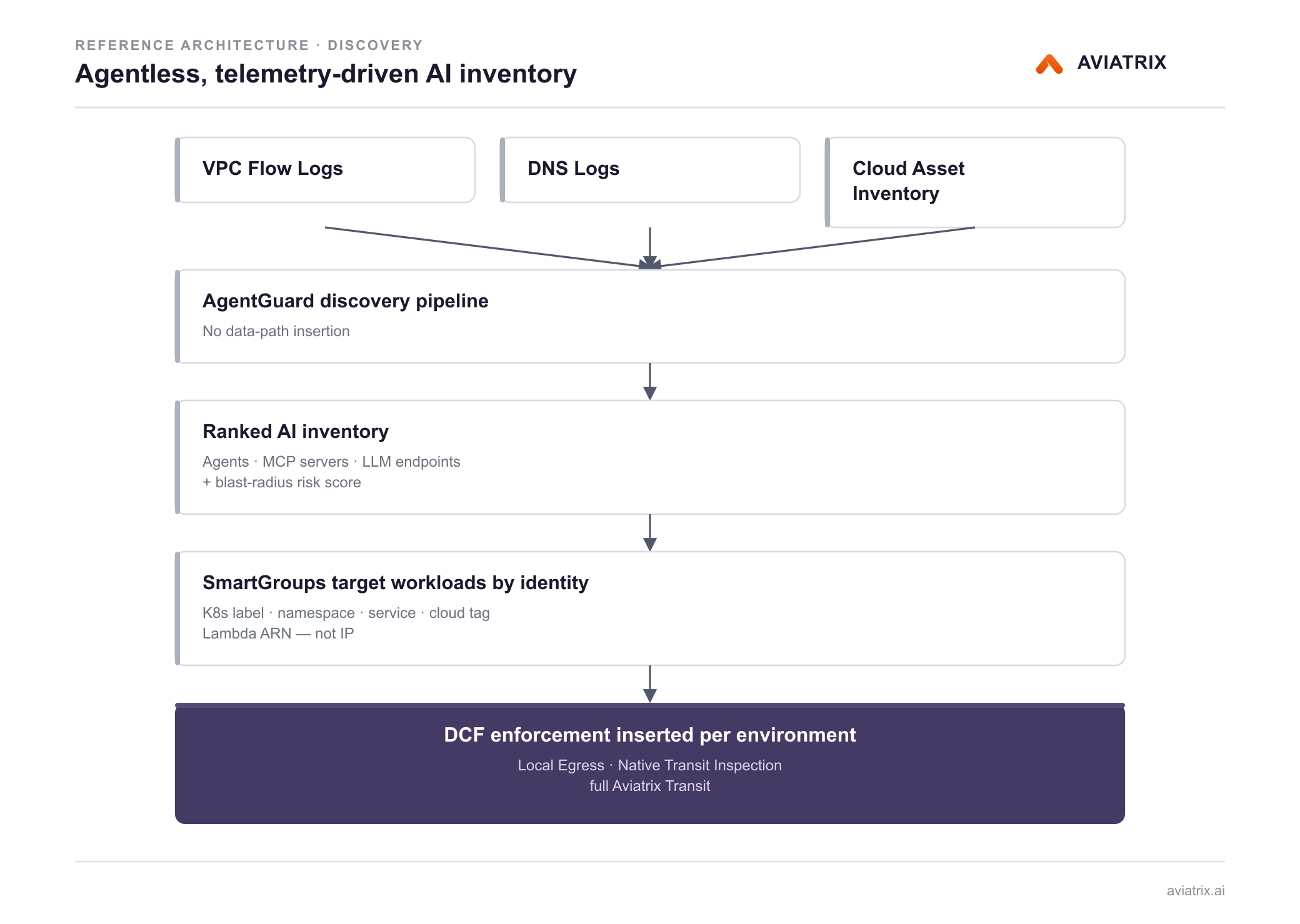
You cannot contain an agent you have not found. AgentGuard discovers AI workloads from gateway logs, VPC flow logs, DNS logs, and cloud resource inventory, without installing software on the workloads, and assigns each a risk level from Low to Critical. The inventory shows where to insert enforcement first, and SmartGroups make each discovered workload a policy target.AgentGuard is an Early Access capability. In its current phase it provides
read-only discovery and analytics, supports AWS only, and does not enforce
policy itself: you write the enforcement policy in DCF. See AgentGuard
Release Phases for
what is available today.
AWS Bedrock AgentCore
In AgentCore VPC mode, each Runtime session places an elastic network interface in a customer-controlled subnet. The subnet’s default route points at an Aviatrix Spoke Gateway, so DCF evaluates every outbound flow before it leaves the subnet. Ingress from client VPCs arrives through PrivateLink endpoints in the same spoke. An out-of-band IAM guardrail denies any Runtime created in PUBLIC networking mode, so a Runtime cannot launch outside the governed landing zone.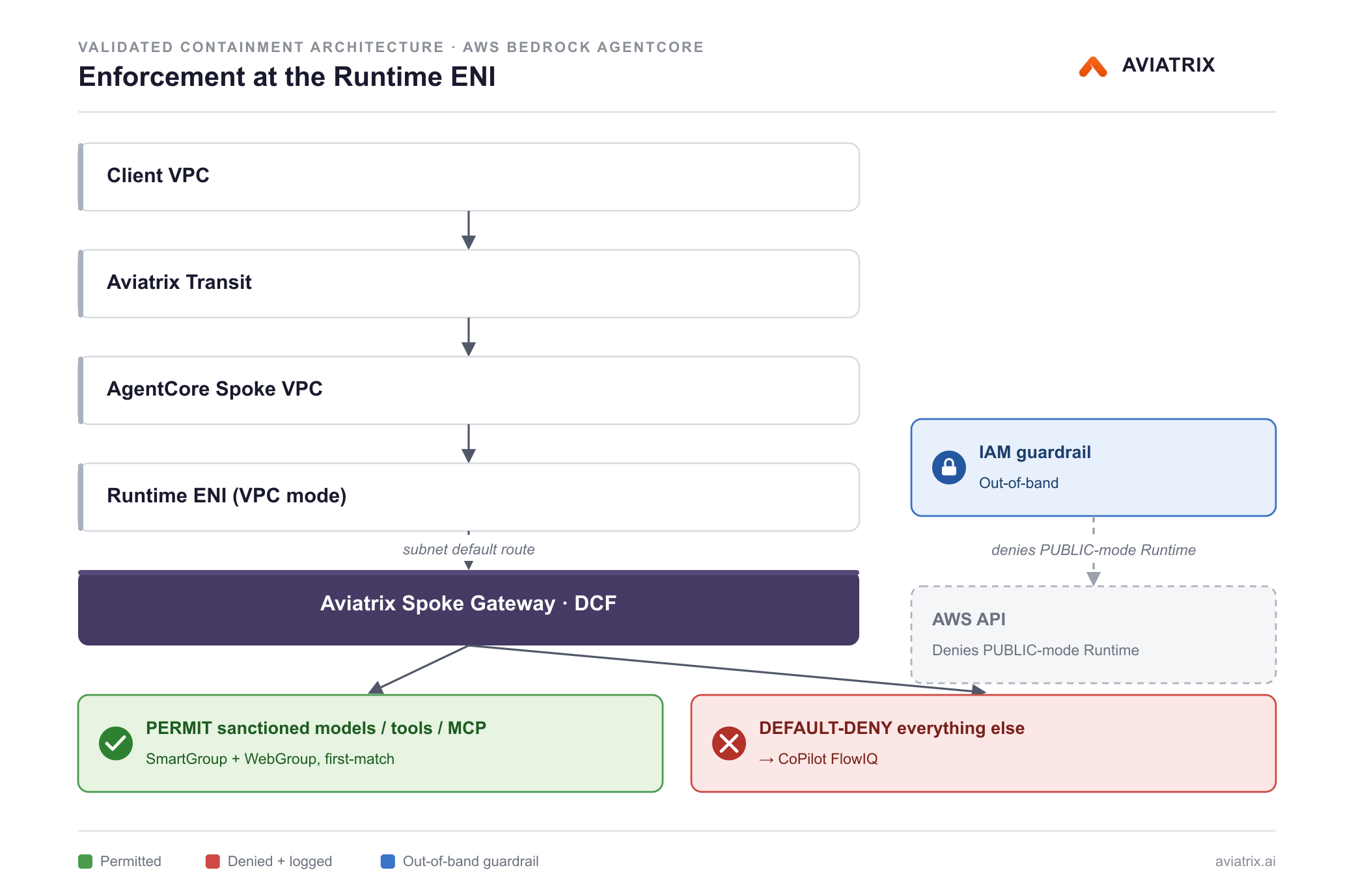
Microsoft Foundry
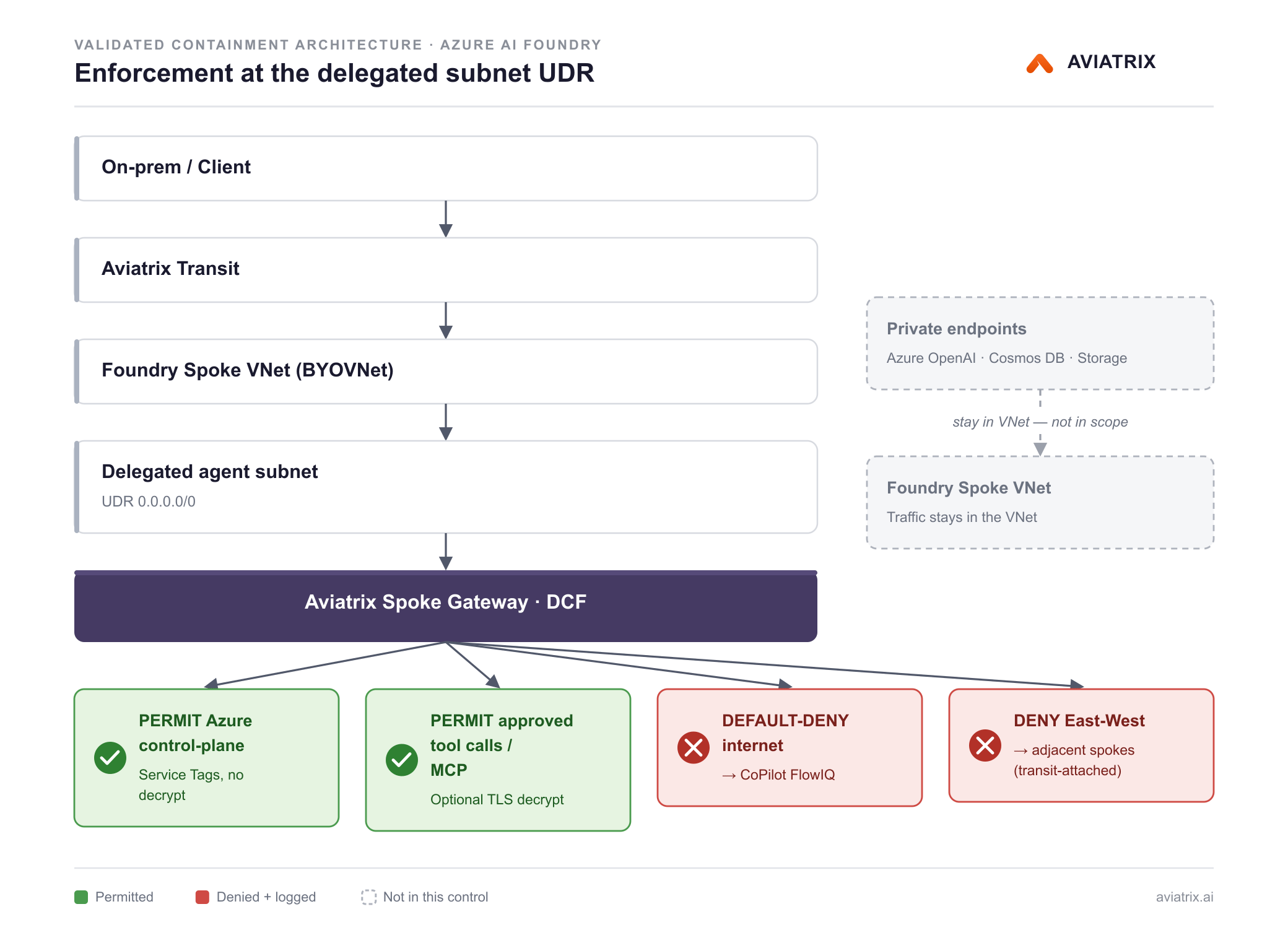
Foundry hosted agents in BYOVNet mode run in a delegated subnet. A User-Defined Route on that subnet sends0.0.0.0/0 to an Aviatrix Spoke Gateway in the
Foundry spoke VNet. Azure control-plane traffic is permitted through Service Tag
SmartGroups, approved tool calls are allow-listed, and all other internet egress
is denied. Private endpoint traffic to Azure OpenAI and other internal resources
stays inside the VNet and does not traverse the gateway. Agents on
Microsoft-managed VNets have no in-path enforcement point and must move to
BYOVNet to use this architecture.
Self-Hosted Agents on Kubernetes
Agents built on LangGraph, AutoGen, CrewAI, or custom runtimes inherit the default-allow egress of their cluster or subnet. Agent pod egress traverses an Aviatrix Spoke Gateway where traffic exits the cluster, with no sidecar and no CNI change. SmartGroups target agent pods by Kubernetes label and namespace, WebGroups permit declared destinations by FQDN, and a SmartGroup deny rule blocks East-West traffic to adjacent workload spokes. The same model applies to Amazon EKS, Azure AKS, Google GKE, self-managed clusters, and VM-based runtimes.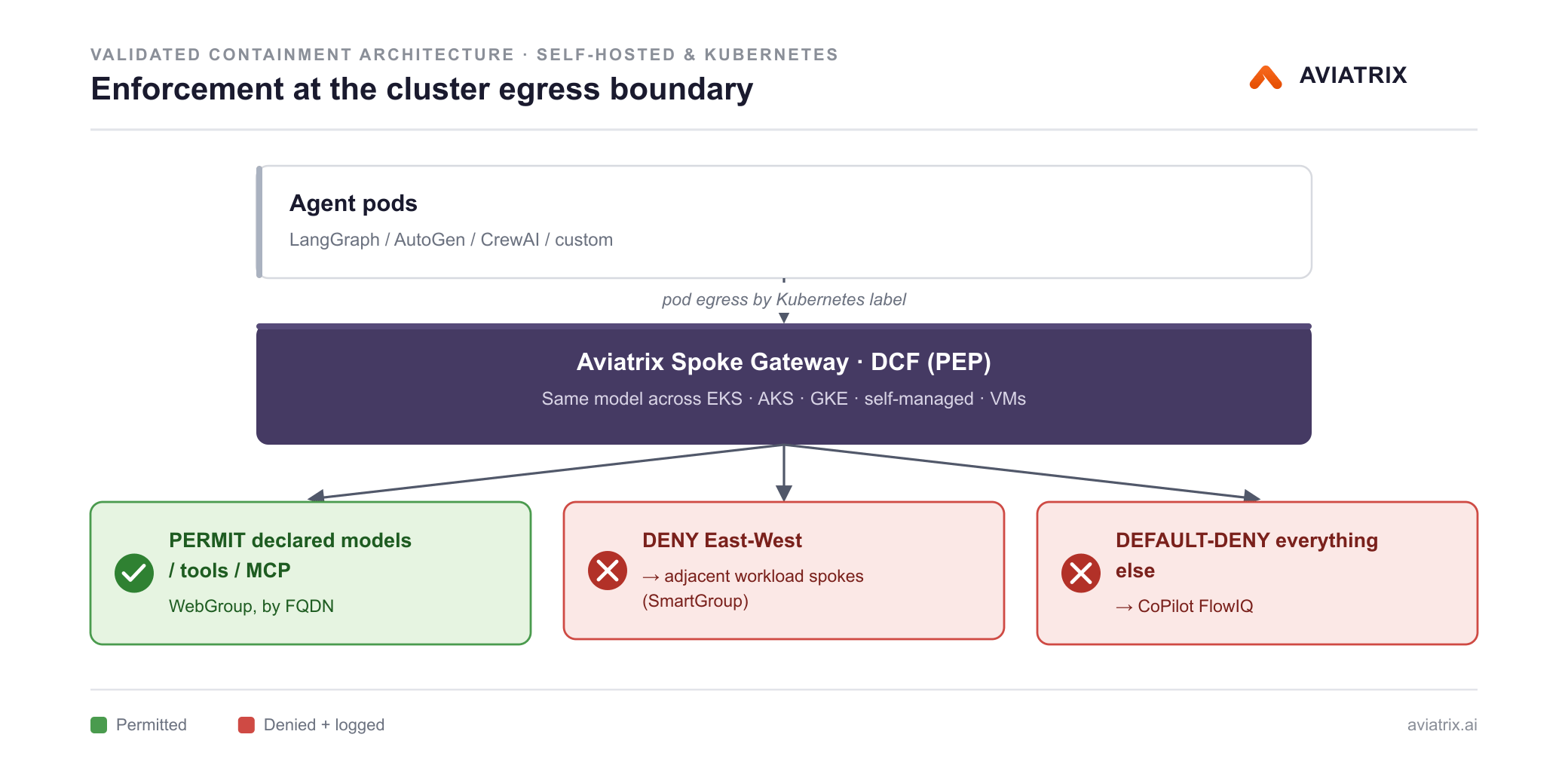
CI/CD Pipelines on Self-Hosted Runners
CI/CD pipelines run trusted code with privileged credentials and make real outbound calls. Self-hosted GitHub Actions runners, deployed as Kubernetes pods or virtual machines in your VPC or VNet, use the same containment model as self-hosted agents: runner egress traverses a Spoke Gateway that permits sanctioned code hosts, registries, and model or MCP endpoints and denies everything else. A compromised job cannot send secrets to, or pull payloads from, a destination that was never declared. GitHub-hosted runners egress from GitHub’s own infrastructure and never traverse your VPC, so in-path containment applies only to self-hosted runners.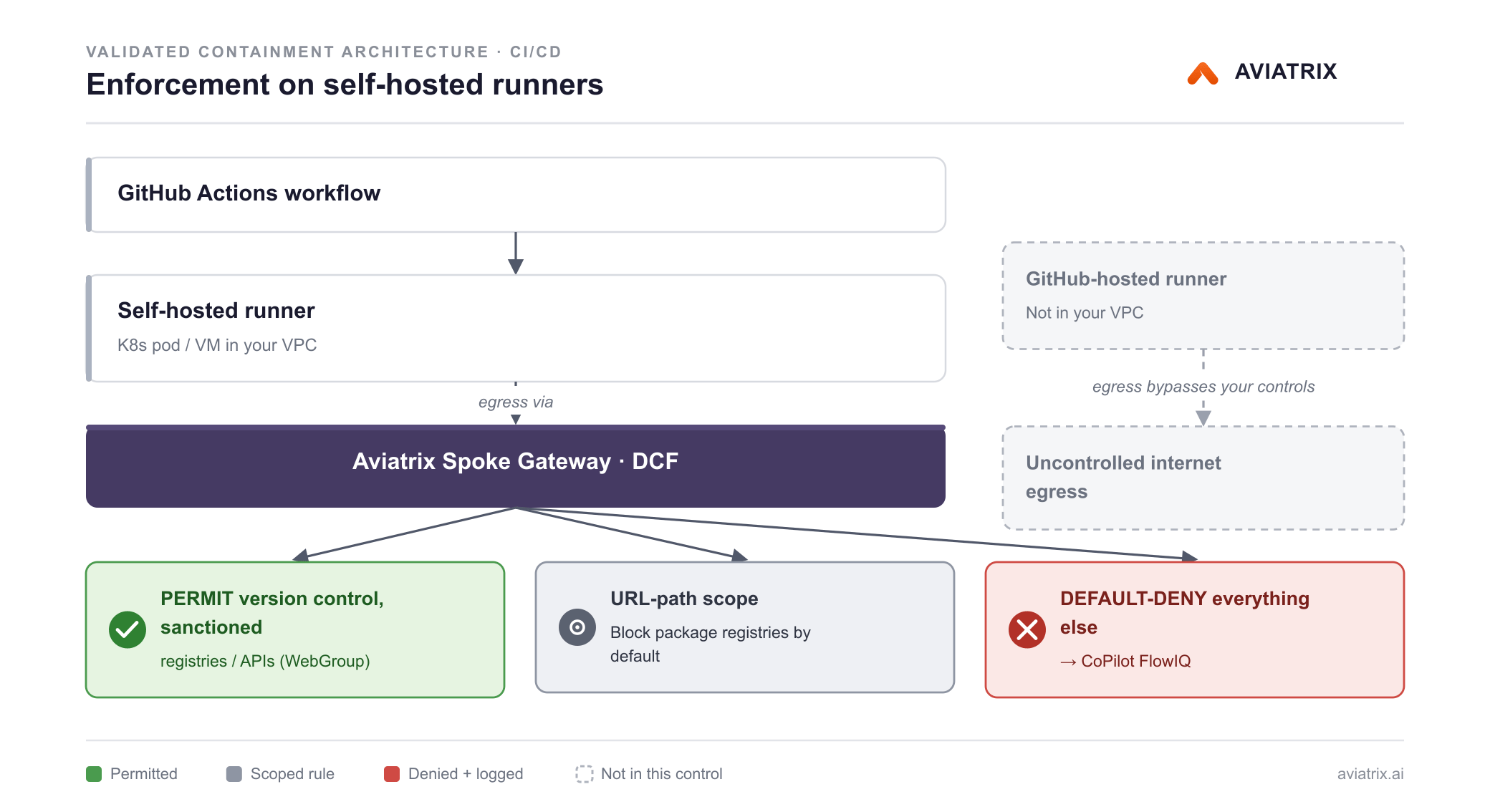
East-West Scoping and FQDN Analysis
Egress containment controls what an agent can reach on the internet. East-West policy controls which internal workloads it can reach. A deny rule between the AI workload SmartGroup and adjacent workload SmartGroups limits an agent to the MCP servers and services you permit. To build accurate allow-lists, the Aviatrix AI FQDN Analyzer surfaces the domains each agent actually contacts, and that observed set becomes the WebGroup allow-list. DCF matches destinations by SNI, so these rules do not require TLS decryption.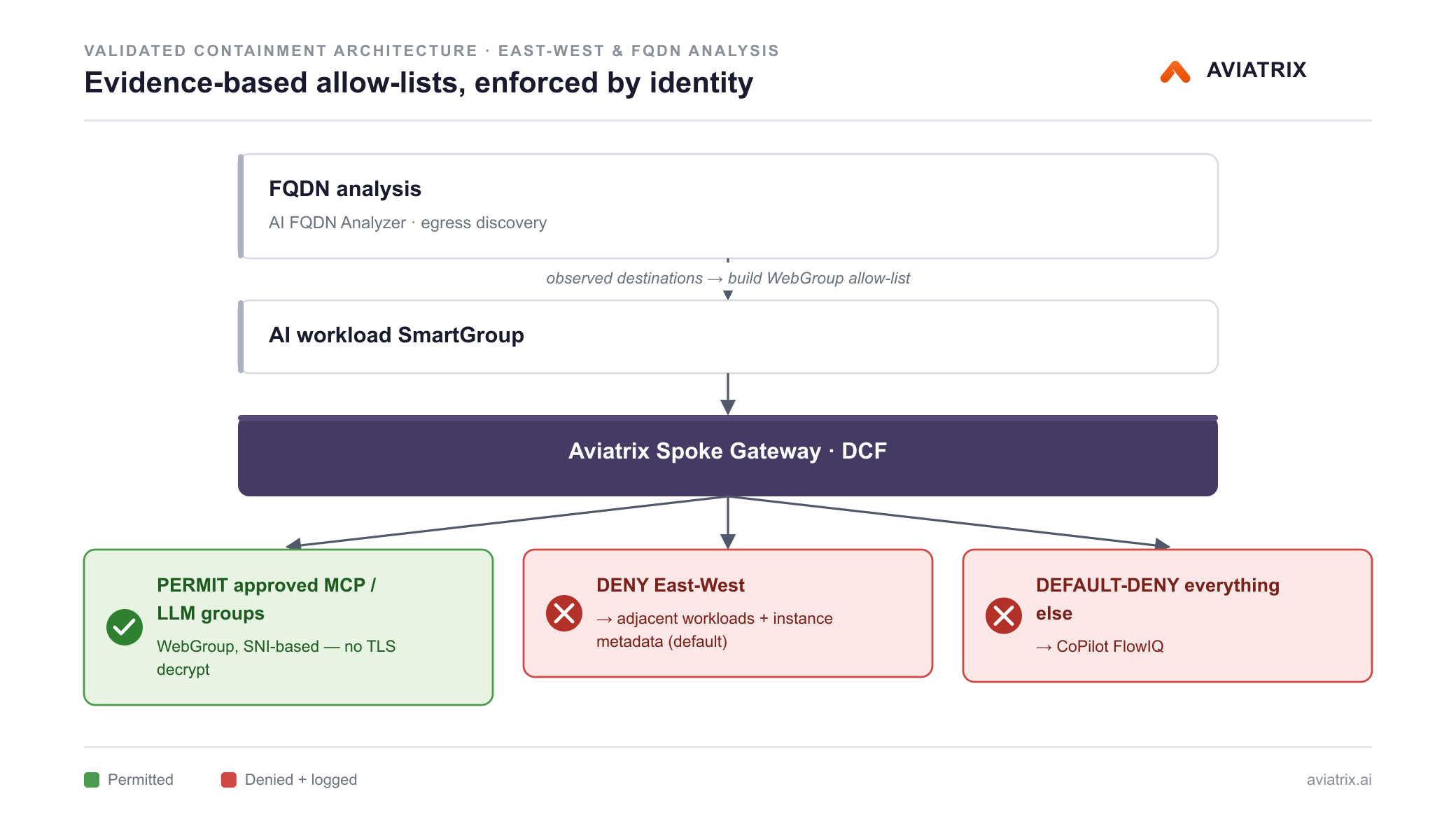
Implementation Guides
The containment pattern is the same regardless of the agent platform: deploy a Spoke Gateway in the agent VPC or VNet, route agent egress through it, and enforce default-deny DCF policy scoped to that workload.- AWS Bedrock AgentCore : Spoke Gateway insertion in the AgentCore VPC, AWS route table enforcement, IAM guardrails preventing PUBLIC-mode runtimes, and DCF policy, with optional selective TLS decryption for supply-chain risk scenarios.
- Microsoft Foundry: With Transit : Foundry BYOVNet spoke attached to an existing Aviatrix Enterprise Transit, with UDR enforcement, ACA runtime exclusions, optional selective TLS inspection, and East-West containment across the transit fabric.
- Microsoft Foundry: Standalone : minimum viable containment footprint for Foundry: a standalone Spoke Gateway in the Foundry VNet with no Aviatrix Transit required. A natural on-ramp that can be extended to the Transit topology later.
- Self-Hosted Agents on Kubernetes : pod-scoped containment policy for LangGraph, AutoGen, CrewAI, and custom agent runtimes deployed as Kubernetes workloads.