> ## Documentation Index
> Fetch the complete documentation index at: https://docs.aviatrix.com/llms.txt
> Use this file to discover all available pages before exploring further.
# VRF Multi-Tenancy
> How Aviatrix VRF isolates traffic between tenants and business units with overlapping IP addresses, and propagates that segment identity end-to-end across transit peerings.
VRF is an Aviatrix segmentation construct that gives each tenant, business unit,
or customer its own routing context, including support for identical or
overlapping IP address ranges between segments. It extends the first-hop VRF
capability introduced in Controller 9.0 end-to-end across transit peerings, so a
segment retains its identity from an Edge or Spoke attachment, across one or
more Transit Gateways, to its destination.
Network Domains
and
Multicloud Transit Segmentation
already isolate traffic using cloud-native VPC/VNet route tables, but both
assume that a prefix advertised into the transit fabric is unique. VRF removes
that assumption: use it when segments must be isolated and one or more of them
use IP address ranges that overlap with another segment.
## Design
### Core Design
VRF removes the implicit constraint of Network Domains and Transit Segmentation.
It gives each segment its own routing context: a separate forwarding table on
the gateway itself, in addition to the cloud-native VPC/VNet route table. As a
result, the same prefix can exist in two segments at once, and each instance
resolves independently in its own table. This is the same technical problem that
first-hop VRF solves in traditional on-premises networking, now applied to
Aviatrix Gateways.
### How It Works
VRF is delivered in two stages that build on each other:
* **First-hop VRF** (Controller 9.0) scoped this per-segment forwarding table to
a single gateway hop, for Site2Cloud connections terminating on a Transit
Gateway. Each domain got its own routing context at that one gateway, which
was enough to resolve overlapping CIDRs arriving from different Site2Cloud
connections, but the isolation did not extend past that gateway.
* **End-to-end segment identity propagation across transit peerings**
(Controller 10.1) extends that same per-segment forwarding table across a
transit-to-transit or Edge/Spoke-to-transit peering. When traffic for a
segment crosses a peering, the receiving Transit Gateway has to know which
segment the packet belongs to, so it can select the matching per-segment table
on its own side. The segment identity has to survive the trip across the
peering, not only the first hop.
Segments with the same name on both sides of a peering are treated as the same
segment (name-based mapping); the peering itself is what has to be explicitly
VRF-aware for this propagation to take effect.
Enable the **Support for VRF** toggle at **Networking > Network
Segmentation > Settings** in CoPilot. Each Network Domain gets its own VRF
automatically; there is no manual VRF ID field to configure.
### Operation Model
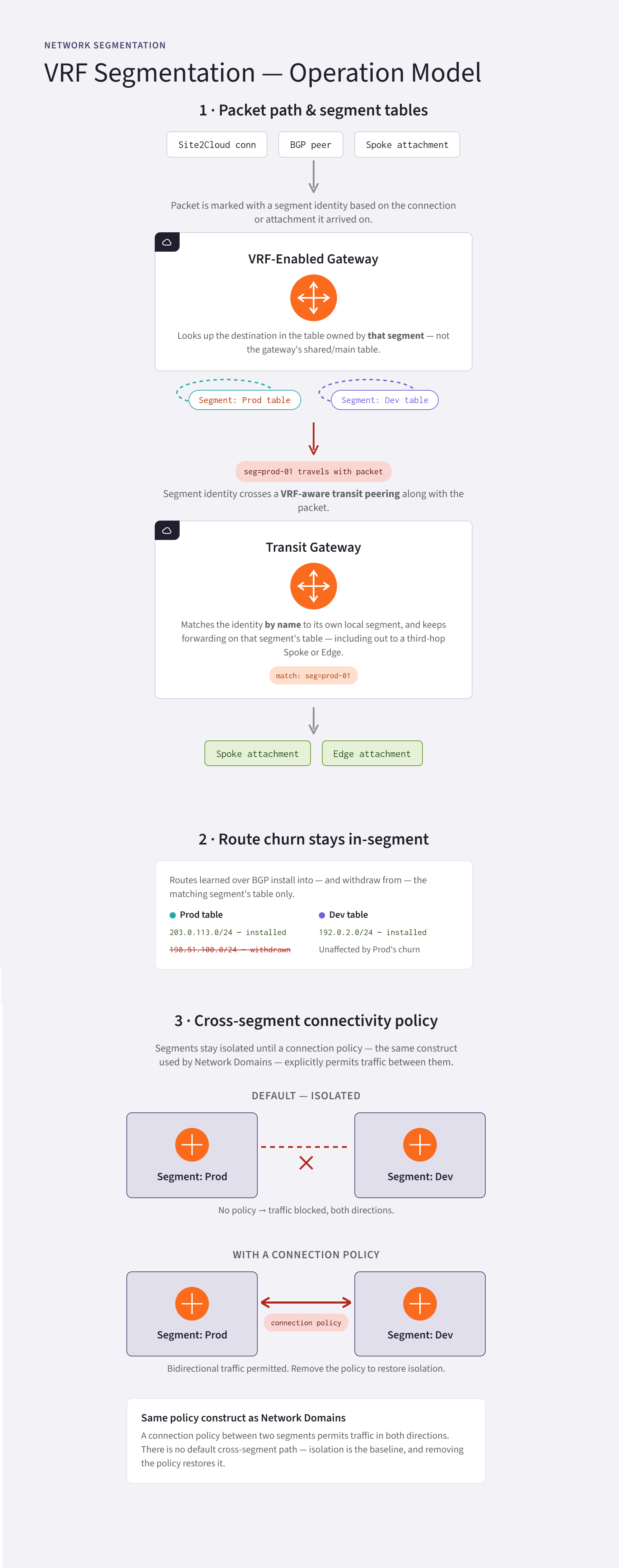 1. A packet enters a VRF-enabled gateway and is marked with its segment identity
based on the connection or attachment it arrived on (for example, a specific
Site2Cloud connection, BGP peer, or spoke attachment).
2. The gateway looks up the packet's destination in the forwarding table that
belongs to that segment, not the gateway's shared/main table.
3. If the destination is reachable through a VRF-aware transit peering, the
segment identity travels with the packet across that peering.
4. The receiving Transit Gateway reads the segment identity, matches it by name
to its own local segment, and continues forwarding using that segment's own
table, including out to a third-hop Spoke or Edge attachment.
5. Routes learned dynamically (for example, over BGP) are installed into, and
withdrawn from, the matching per-segment table rather than the shared table,
so route churn in one segment does not affect another.
Cross-segment connectivity does not happen unless you explicitly allow it. A
connection policy between two segments (the same policy construct used by
Network Domains) permits bidirectional traffic between them; removing the policy
restores isolation.
## Key Features
### Per-Segment Route Isolation
Each segment gets its own forwarding table, independent of any other segment's
table on the same gateway.
* Identical or overlapping CIDRs in different segments do not collide, because
each segment resolves destinations in its own table.
* A segment's cloud-native VPC/VNet route table only ever contains that
segment's own routes. It never carries another segment's overlapping CIDRs.
* Dynamic routes (BGP-learned) install into and withdraw from the correct
per-segment table automatically.
### Segment Identity Propagation Across Transit Peerings
This release adds a new capability: a segment's isolation extends beyond the
gateway it entered on.
* A VRF-aware transit-to-transit or Edge/Spoke-to-transit peering preserves
segment identity across the peering.
* Segments are mapped between peered gateways by name: a segment named the same
way on both sides of the peering is treated as one continuous segment.
* Isolation holds even when the two sides of the peering are in different clouds
or regions.
### Controlled Cross-Segment Connectivity
Segments are isolated by default; you decide when two segments should talk to
each other.
* A connection policy between two segments allows bidirectional traffic between
them, using the same policy model as Network Domains.
* Removing a connection policy restores isolation without requiring any other
configuration change.
### Compatibility with Encryption and Path Features
Segment isolation is validated to keep working alongside Aviatrix's performance
and resiliency features on the same peering, not only on a plain tunnel.
* Segment identity propagation is validated against High Performance Encryption,
which spreads a single peering's traffic across multiple encrypted subtunnels.
* Segment identity propagation is validated against ActiveMesh multi-path
tunnels.
* IPv6 traffic is supported within a VRF-enabled segment.
## When to Use
### Consolidating Multiple Tenants Onto Shared Transit Infrastructure
You operate a shared transit backbone, as a service provider or as an internal
platform team serving multiple internal customers. Your tenants' networks were
never coordinated with each other, so some of them use identical or overlapping
private address ranges. Use VRF to isolate each tenant's routing without
renumbering any of them, while still using one shared set of Transit Gateways
rather than a separate Controller or Transit deployment per tenant.
### Segmenting Business Units After a Merger or Acquisition
Two business units, divisions, or recently acquired subsidiaries need to be kept
isolated from each other on the network, but at least one of their address
ranges overlaps with the other's. Network Domains alone cannot represent that
overlap in a shared transit route table; VRF can, because each business unit
resolves its own destinations in its own table.
### Extending an Existing On-Premises VRF-Lite Design Into the Cloud
Your on-premises network already segments traffic per business unit or customer
using VRF-lite or a similar per-VRF WAN design. You want the cloud side of your
Aviatrix deployment to preserve that same per-segment boundary once it reaches
the cloud, rather than collapsing everything into one flat routing domain.
First-hop VRF already lets a Transit Gateway preserve segment boundaries for
Site2Cloud connections; this feature extends that boundary further, across
transit peerings, toward the rest of your Aviatrix fabric.
## Best Practices
* **Name segments consistently across every transit you peer.** Segment mapping
across a VRF-aware peering is name-based. A typo or inconsistent naming
convention between two transits results in two segments that fail to map to
each other rather than a visible error.
* **Reserve non-overlapping CIDRs for anything shared across every segment.**
Shared services that every segment needs to reach are simplest to design with
a non-overlapping address range, since a shared destination that itself
overlaps with a segment's own range is harder to route unambiguously.
* **Treat connection policies between segments as a deliberate exception, not a
default.** Segments are isolated by default specifically so that overlapping
or sensitive address space in one segment is never reachable from another
segment without an explicit decision.
* **Plan for a bounded number of segments, and confirm the actual limit for your
target release before committing to a design.** Design for no more than 10 to
20 segments per Controller. This range reflects current design guidance, not a
load-tested maximum for this release; confirm the published limit for your
target release before finalizing a design.
* **VRF is supported on AWS, Azure, and GCP.** Confirm your target segments run
in one of these clouds before you design around VRF.
* **Adopt first-hop VRF before relying on cross-peering propagation.** Since
end-to-end propagation extends the same per-segment table that first-hop VRF
establishes at the gateway, confirm your Site2Cloud or BGP-facing gateways are
already using first-hop VRF correctly before layering transit peering
propagation on top of it.
## Comparison with Network Domains and Transit Segmentation
VRF does not replace Network Domains or Transit Segmentation. It addresses the
one case they cannot: segments whose address space overlaps.
| | Network Domains / Transit Segmentation | VRF |
| --------------------------------- | --------------------------------------------------------------------------------- | ---------------------------------------------------------------------------------------------------------- |
| Isolation enforced at | Cloud-native VPC/VNet route tables and Aviatrix-programmed transit route tables | A separate forwarding table per segment on the gateway itself, in addition to the cloud-native route table |
| Overlapping CIDRs across segments | Not supported: a shared route table cannot hold two next hops for the same prefix | Supported: each segment resolves the prefix independently, in its own table |
| Cross-segment connectivity | Connection policy | Connection policy (same model) |
| Scope of isolation | Within the Transit Segmentation topology (Spoke and Transit VPC/VNets) | A segment scoped at the gateway, extendable end-to-end across VRF-aware transit peerings |
If none of your segments need overlapping address space, Network Domains and
Transit Segmentation alone are sufficient and simpler to reason about. Reach for
VRF specifically when overlapping IP addresses across segments are a
requirement, not a preference.
1. A packet enters a VRF-enabled gateway and is marked with its segment identity
based on the connection or attachment it arrived on (for example, a specific
Site2Cloud connection, BGP peer, or spoke attachment).
2. The gateway looks up the packet's destination in the forwarding table that
belongs to that segment, not the gateway's shared/main table.
3. If the destination is reachable through a VRF-aware transit peering, the
segment identity travels with the packet across that peering.
4. The receiving Transit Gateway reads the segment identity, matches it by name
to its own local segment, and continues forwarding using that segment's own
table, including out to a third-hop Spoke or Edge attachment.
5. Routes learned dynamically (for example, over BGP) are installed into, and
withdrawn from, the matching per-segment table rather than the shared table,
so route churn in one segment does not affect another.
Cross-segment connectivity does not happen unless you explicitly allow it. A
connection policy between two segments (the same policy construct used by
Network Domains) permits bidirectional traffic between them; removing the policy
restores isolation.
## Key Features
### Per-Segment Route Isolation
Each segment gets its own forwarding table, independent of any other segment's
table on the same gateway.
* Identical or overlapping CIDRs in different segments do not collide, because
each segment resolves destinations in its own table.
* A segment's cloud-native VPC/VNet route table only ever contains that
segment's own routes. It never carries another segment's overlapping CIDRs.
* Dynamic routes (BGP-learned) install into and withdraw from the correct
per-segment table automatically.
### Segment Identity Propagation Across Transit Peerings
This release adds a new capability: a segment's isolation extends beyond the
gateway it entered on.
* A VRF-aware transit-to-transit or Edge/Spoke-to-transit peering preserves
segment identity across the peering.
* Segments are mapped between peered gateways by name: a segment named the same
way on both sides of the peering is treated as one continuous segment.
* Isolation holds even when the two sides of the peering are in different clouds
or regions.
### Controlled Cross-Segment Connectivity
Segments are isolated by default; you decide when two segments should talk to
each other.
* A connection policy between two segments allows bidirectional traffic between
them, using the same policy model as Network Domains.
* Removing a connection policy restores isolation without requiring any other
configuration change.
### Compatibility with Encryption and Path Features
Segment isolation is validated to keep working alongside Aviatrix's performance
and resiliency features on the same peering, not only on a plain tunnel.
* Segment identity propagation is validated against High Performance Encryption,
which spreads a single peering's traffic across multiple encrypted subtunnels.
* Segment identity propagation is validated against ActiveMesh multi-path
tunnels.
* IPv6 traffic is supported within a VRF-enabled segment.
## When to Use
### Consolidating Multiple Tenants Onto Shared Transit Infrastructure
You operate a shared transit backbone, as a service provider or as an internal
platform team serving multiple internal customers. Your tenants' networks were
never coordinated with each other, so some of them use identical or overlapping
private address ranges. Use VRF to isolate each tenant's routing without
renumbering any of them, while still using one shared set of Transit Gateways
rather than a separate Controller or Transit deployment per tenant.
### Segmenting Business Units After a Merger or Acquisition
Two business units, divisions, or recently acquired subsidiaries need to be kept
isolated from each other on the network, but at least one of their address
ranges overlaps with the other's. Network Domains alone cannot represent that
overlap in a shared transit route table; VRF can, because each business unit
resolves its own destinations in its own table.
### Extending an Existing On-Premises VRF-Lite Design Into the Cloud
Your on-premises network already segments traffic per business unit or customer
using VRF-lite or a similar per-VRF WAN design. You want the cloud side of your
Aviatrix deployment to preserve that same per-segment boundary once it reaches
the cloud, rather than collapsing everything into one flat routing domain.
First-hop VRF already lets a Transit Gateway preserve segment boundaries for
Site2Cloud connections; this feature extends that boundary further, across
transit peerings, toward the rest of your Aviatrix fabric.
## Best Practices
* **Name segments consistently across every transit you peer.** Segment mapping
across a VRF-aware peering is name-based. A typo or inconsistent naming
convention between two transits results in two segments that fail to map to
each other rather than a visible error.
* **Reserve non-overlapping CIDRs for anything shared across every segment.**
Shared services that every segment needs to reach are simplest to design with
a non-overlapping address range, since a shared destination that itself
overlaps with a segment's own range is harder to route unambiguously.
* **Treat connection policies between segments as a deliberate exception, not a
default.** Segments are isolated by default specifically so that overlapping
or sensitive address space in one segment is never reachable from another
segment without an explicit decision.
* **Plan for a bounded number of segments, and confirm the actual limit for your
target release before committing to a design.** Design for no more than 10 to
20 segments per Controller. This range reflects current design guidance, not a
load-tested maximum for this release; confirm the published limit for your
target release before finalizing a design.
* **VRF is supported on AWS, Azure, and GCP.** Confirm your target segments run
in one of these clouds before you design around VRF.
* **Adopt first-hop VRF before relying on cross-peering propagation.** Since
end-to-end propagation extends the same per-segment table that first-hop VRF
establishes at the gateway, confirm your Site2Cloud or BGP-facing gateways are
already using first-hop VRF correctly before layering transit peering
propagation on top of it.
## Comparison with Network Domains and Transit Segmentation
VRF does not replace Network Domains or Transit Segmentation. It addresses the
one case they cannot: segments whose address space overlaps.
| | Network Domains / Transit Segmentation | VRF |
| --------------------------------- | --------------------------------------------------------------------------------- | ---------------------------------------------------------------------------------------------------------- |
| Isolation enforced at | Cloud-native VPC/VNet route tables and Aviatrix-programmed transit route tables | A separate forwarding table per segment on the gateway itself, in addition to the cloud-native route table |
| Overlapping CIDRs across segments | Not supported: a shared route table cannot hold two next hops for the same prefix | Supported: each segment resolves the prefix independently, in its own table |
| Cross-segment connectivity | Connection policy | Connection policy (same model) |
| Scope of isolation | Within the Transit Segmentation topology (Spoke and Transit VPC/VNets) | A segment scoped at the gateway, extendable end-to-end across VRF-aware transit peerings |
If none of your segments need overlapping address space, Network Domains and
Transit Segmentation alone are sufficient and simpler to reason about. Reach for
VRF specifically when overlapping IP addresses across segments are a
requirement, not a preference.